
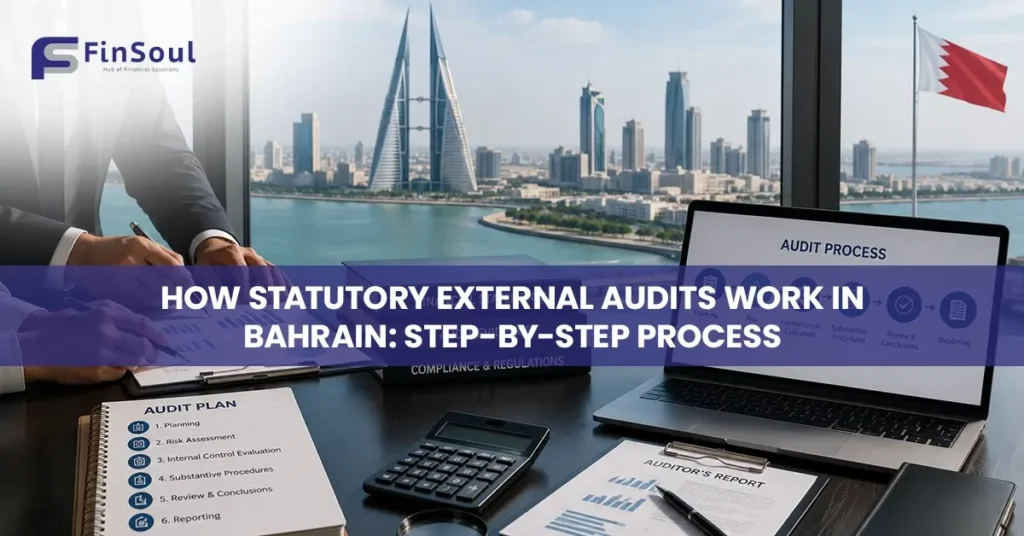
Every company registered in the Kingdom of Bahrain must meet strict financial reporting obligations, and at the center of this requirement sits the statutory audit Bahrain businesses are legally bound to complete each year. Whether you run a small trading company or a large multinational subsidiary, understanding how this process works helps you stay compliant, avoid penalties, and build trust with regulators, investors, and banks. In this guide, Finsoul Bahrain breaks down exactly how the engagement unfolds, from appointment to final report.
What Is a Statutory Audit in Bahrain?
A statutory audit is an independent, legally mandated examination of a company’s financial statements to confirm they present a true and fair view of its financial position. Unlike an internal audit, which a company conducts voluntarily for its own management, a statutory audit Bahrain requirement comes directly from the law, specifically the Bahrain Commercial Companies Law and regulations issued by the Ministry of Industry and Commerce (MOICT) and, for financial institutions, the Central Bank of Bahrain (CBB).
The purpose of the statutory external audit Bahrain authorities require is simple: to protect shareholders, creditors, and the public by ensuring financial statements are accurate, complete, and free from material misstatement whether caused by error or fraud.
Legal Framework Governing Statutory Audits in Bahrain
Companies incorporated in Bahrain, including those operating in free zones, must appoint a licensed external auditor registered with the MOICT. Banks, insurance companies, and investment firms fall under additional CBB rulebooks that impose stricter reporting timelines and disclosure standards. This regulatory backdrop is why the statutory audit process Bahrain companies follow tends to be more rigorous than in jurisdictions with lighter compliance regimes.
Auditors in Bahrain generally apply International Standards on Auditing (ISA) and prepare financial statements in accordance with International Financial Reporting Standards (IFRS), giving international stakeholders confidence in locally audited reports.
Who Needs a Statutory Audit in Bahrain?
Nearly all Bahrain-incorporated entities, including Limited Liability (WLL) companies, Bahrain Shareholding Companies (BSC), and branches of foreign companies, are required to undergo an annual statutory audit Bahrain regulators can verify against filed financial records. Even smaller companies that may be exempt from certain disclosure requirements often still need audited accounts to renew commercial registrations, secure financing, or satisfy shareholder agreements.
Documents Typically Required for a Statutory Audit in Bahrain
Before the audit fieldwork begins, businesses should prepare the following documents to help keep the audit process smooth and avoid unnecessary delays:
- Bank statements
- Trial balances
- General ledgers
- Fixed asset registers
- Sales invoices
- Purchase invoices
- Payroll records
- Lease agreements
- Prior-year audited financial statements
- Supporting contracts for related-party transactions
- Pricing agreements for related-party dealings
Organizing these documents in advance can help shorten audit timelines and reduce back-and-forth queries with the audit team.
Typical Timeline for a Statutory Audit in Bahrain
While the exact timeline depends on the company’s size and complexity, most statutory audits in Bahrain generally follow these stages:
- Planning and Risk Assessment: A few days to one week
- Fieldwork and Evidence Gathering: One to three weeks
- Report Drafting and Management Review: A few additional days
- Final Audit Opinion: Issued after the review and completion of the audit procedures
Companies with clean, well-reconciled books throughout the year can generally complete the audit more quickly than businesses that need to reconstruct records or resolve issues at year-end.
Step-by-Step Statutory Audit Process in Bahrain
Step 1: Auditor Appointment
The company’s shareholders or board formally appoint a licensed external auditor. This appointment must be documented, and the auditor must be independent of company management to preserve objectivity throughout the statutory audit process Bahrain law demands.
Step 2: Planning and Risk Assessment
The audit team studies the company’s industry, internal controls, and prior financial statements to identify areas of higher risk such as revenue recognition, related-party transactions, or inventory valuation. This planning phase shapes the scope and depth of the entire statutory audit Bahrain engagement.
Step 3: Understanding Internal Controls
Auditors evaluate how the company records transactions, safeguards assets, and prevents errors. Weak controls typically mean more extensive substantive testing later in the process.
Step 4: Fieldwork and Evidence Gathering
This is the core of any statutory external audit Bahrain engagement. Auditors examine bank confirmations, invoices, contracts, payroll records, and supporting documentation. They may also perform physical inventory counts and send confirmation letters to customers, suppliers, and banks.
Step 5: Testing Financial Statement Balances
Auditors verify that reported figures for assets, liabilities, revenue, and expenses are accurate and properly classified under IFRS. Any discrepancies are flagged for management to explain or correct.
Step 6: Reviewing Compliance and Disclosures
Beyond the numbers, auditors check that statutory disclosures such as related-party transactions, contingent liabilities, and going-concern assessments are properly presented, since these are frequently scrutinized during regulatory review.
Step 7: Drafting and Issuing the Audit Report
Once fieldwork concludes, the auditor issues an opinion: unqualified (clean), qualified, adverse, or disclaimer of opinion. This report accompanies the audited financial statements submitted to authorities.
Step 8: Filing with Regulatory Authorities
The finalized, audited financial statements are filed with the MOICT (and CBB, where applicable) as part of annual compliance. Missing this step, or filing late, can result in fines or complications renewing the commercial registration.
Statutory Audit vs. Internal Audit vs. Tax Audit
Although these audits may seem similar, each serves a different purpose and focuses on a specific area of business compliance and financial management. The table below highlights the key differences between statutory, internal, and tax audits.
| Audit Type | Main Purpose | Key Focus | Requirement |
| Statutory Audit | To verify the accuracy of financial statements | Financial reporting and regulatory compliance | Legally required for applicable businesses and results in a formal audit opinion filed with regulators |
| Internal Audit | To improve business operations and manage risks | Operational efficiency, internal controls, and risk management | Generally voluntary and conducted for internal management purposes |
| Tax Audit | To verify tax compliance | Tax records, calculations, and compliance with tax requirements | Focused specifically on tax compliance |
Common Challenges Businesses Face
Many companies underestimate how long the statutory audit process Bahrain entities go through actually takes, especially when documentation is incomplete or internal controls are weak. Delays in gathering bank confirmations, disorganized invoicing records, and last-minute reconciliations are among the most frequent bottlenecks that push audits past their deadlines.
Why Choose Professional External Audit Services in Bahrain
Engaging experienced external audit services Bahrain firms provide is one of the most effective ways to keep the process smooth and predictable. A knowledgeable audit partner not only ensures technical compliance with IFRS and ISA but also helps management understand findings, strengthen internal controls, and prepare more efficiently for future audit cycles.
Reliable external audit services Bahrain businesses trust also reduce the risk of regulatory penalties by ensuring filings are accurate and submitted on time, giving company leadership one less thing to worry about during a busy financial year.
Ready to Simplify Your Statutory Audit in Bahrain?
Managing a statutory audit does not have to be stressful. From preparing financial records and completing audit procedures to meeting MOICT and CBB filing requirements, Finsoul Bahrain provides reliable support throughout the entire audit process. Our experienced team helps businesses stay compliant, avoid unnecessary delays, and complete their statutory audit with confidence.
Contact Finsoul Bahrain today to discuss your audit requirements and get professional support from start to finish.
Location
Office 41, Building 2737, Road 3649, Seef, Al Manama 436, Bahrain
Email
info@fin-soul.com
Phone
+973 3383 2422
Conclusion
A statutory audit Bahrain engagement is more than a legal box to tick; it’s a safeguard that protects your company’s credibility with regulators, banks, and investors. Understanding each stage of this journey, from auditor appointment to final filing, helps you prepare documentation early and avoid last-minute stress. Whether you’re a growing SME or an established enterprise, partnering with a firm that understands the statutory audit Bahrain landscape inside and out makes all the difference. Finsoul Bahrain is ready to guide you through every step, ensuring your obligations are met accurately, on time, and with full regulatory confidence.
Frequently Asked Questions
How long does a statutory audit in Bahrain usually take?
Most audits take between two and six weeks, depending on company size and how organized the financial records are going into the engagement.
Is a statutory audit mandatory for all companies in Bahrain?
Yes, most Bahrain-incorporated entities, including WLLs and BSCs, must undergo an annual audit, though specific exemptions can apply to very small businesses.
Who can perform a statutory audit in Bahrain?
Only auditors licensed and registered with the Ministry of Industry and Commerce are authorized to issue statutory audit opinions in the Kingdom.
What happens if a company misses its audit filing deadline?
Late filings can lead to financial penalties, complications renewing the commercial registration, and increased regulatory scrutiny in future years.
How can Finsoul Bahrain help with my company’s audit?
Finsoul Bahrain manages the entire audit process end-to-end, from planning to final MOICT filing, while also offering related tax and advisory support.